
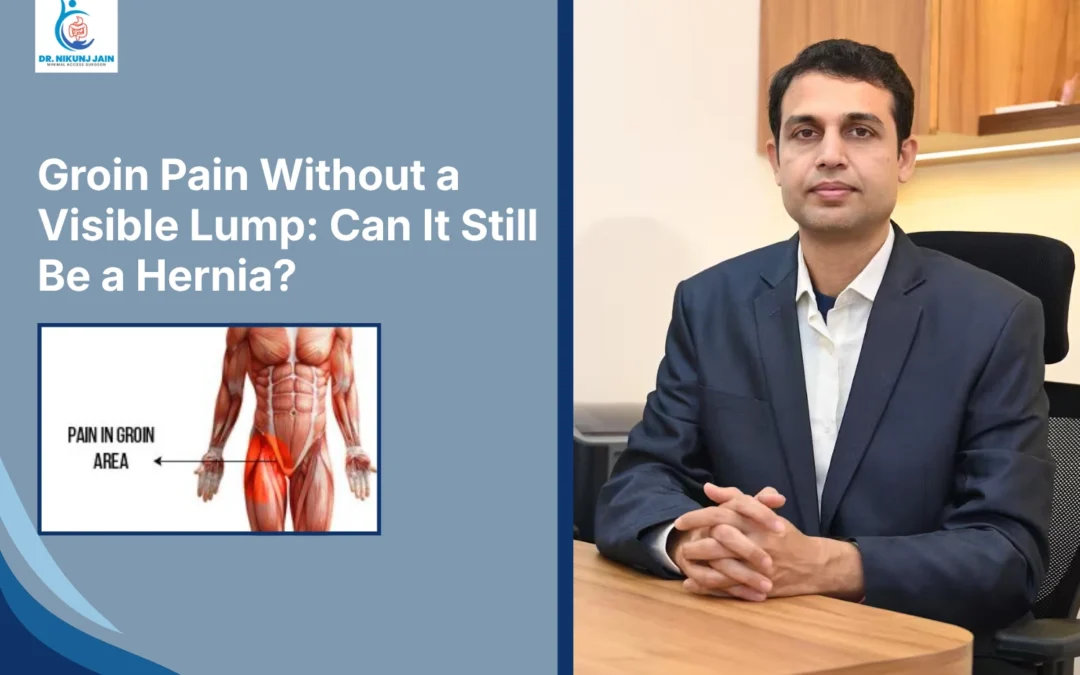
Groin pain often accompanies a hernia; however, there may not always be a visible bulge. If a person has chronic discomfort, heaviness, a pulling sensation, or pain in the groin without any obvious swelling, the cause could be an early or small hernia.
At the same time, several other conditions can also cause groin pain. Therefore, it is important to identify whether the pain is related to a hernia or another underlying problem.
If you are experiencing persistent groin pain, discomfort, or heaviness, consult Dr. Nikunj Jain, a surgical gastroenterologist and one of the best doctors for groin pain in Indore, for proper evaluation, diagnosis, and appropriate treatment.
Table of Contents
A Hernia May Exist Without a Visible Lump
A hernia develops when tissues such as fat or parts of the intestine push through weaknesses in the abdominal muscles. However, a hernia lump might not always be visible or palpable. Small hernias may only cause groin discomfort without any protrusion. Moreover, some hernias may only be visible when one is standing or coughing. If a hernia is small or deep, it may cause groin pain without causing any swelling.
Symptoms of Hernia
Groin pain caused by hernias can often take a variety of forms. It may range from occasional to constant and mild to severe. Some people may experience discomfort during physical activities while others may feel pain even at rest. Moreover, each person may experience hernia-related groin pain differently. The following are some examples of pain that may occur during a hernia:
• Aching or burning discomfort in the groin
• Heaviness in the lower abdomen
• Pain when coughing or sneezing
• Discomfort when lifting something heavy
• Pulling sensation around the groin
• Pain when standing for a long time
• Groin discomfort when exercising
• Groin pain that goes away when lying down
These symptoms, however, cannot be used to confirm a hernia because several other conditions may also lead to similar groin discomfort or pain.
Occult Hernias Can Be Difficult to Notice
A hernia with symptoms but without a visible lump is also known as an occult hernia. Most often, individuals with occult hernias are unaware that they have a hernia. Usually, a lump can only be seen or felt when coughing or straining. A hernia may also be detected when the doctor asks the patient to stand or cough.
Other Causes of Groin Pain
Groin pain may also be caused by:
• Muscle strain
• Hip problems
• Abdominal muscle or tendon injury
• Nerve-related problems
• Prostate issues
• Infections
• Swollen lymph nodes
Proper diagnosis is important to identify the exact cause and decide the right treatment.
How a Hernia Is Diagnosed
The initial evaluation for a hernia consists of obtaining a detailed history of symptoms. The doctor may ask if one feels pain while coughing, lifting, or exercising. Next, the physician will conduct a thorough physical examination of the groin while the patient is standing. The doctor may also ask them to cough or strain to see if they can see or feel a hernia.
If the symptoms suggest hernia, but the diagnosis is not clear on physical examination, an ultrasound scan of the groin may be advised. In certain circumstances, an MRI or CT scan may also be necessary to rule out other causes of groin discomfort or pain.
When Groin Pain Needs Medical Attention
Groin pain that occurs frequently when exercising or working out, or persists for several days, should not be ignored since it may be a sign of a hernia. The same goes for groin pain that is progressively getting worse. One should seek immediate medical attention in case of sudden, severe groin pain or pain that comes with nausea or vomiting. In addition, if the person notices a swollen groin area that does not seem to be improving, it is best to see a doctor.
Treatment Depends on the Diagnosis
• Muscle strain: Usually improves with rest, reduced activity, and appropriate care.
• Hernia: Hernias generally do not heal on their own and may require surgical repair.
• Surgical options: Hernia surgery may be performed using open, laparoscopic, or robotic-assisted techniques.
• Choice of surgery: The most suitable approach depends on the type and size of the hernia, symptoms, overall health, and individual patient factors.
• Proper diagnosis is important: A detailed examination helps determine whether surgery is needed and which treatment approach is most appropriate.
Conclusion
Yes, it is absolutely possible to have groin pain from a hernia with no visible lump. Small hernias or those that are concealed may cause groin discomfort as well as pain while coughing, lifting, or exercising. However, there are several other causes of groin pain.
One should see Dr. Nikunj Jain, Best Hernia Surgeon in Indore, for an examination if they are suffering from chronic or recurring groin discomfort or pain. It is crucial to detect the precise cause of groin pain since it will help identify the kind of treatment that is necessary to get better.
FAQs
Q1. Can you have a hernia without a lump?
Yes. Small or hidden hernias may cause pain or discomfort without producing an obvious swelling.
Q2. What does a hidden hernia feel like?
It may cause aching, burning, heaviness, pressure or a pulling sensation in the groin.
Q3. Can an inguinal hernia cause pain without swelling?
Yes. An early or small inguinal hernia may cause symptoms before a noticeable bulge appears.
Q4. Does hernia pain increase while coughing?
It can. Coughing increases pressure inside the abdomen and may make hernia-related discomfort more noticeable.
Q5. Can gym workouts cause groin pain?
Yes. Muscle strains and hernias can both cause groin discomfort after exercise or heavy lifting.
Q6. How is a hidden hernia diagnosed?
Diagnosis may involve physical examination and, when necessary, imaging such as ultrasound, MRI or CT.
Q7. Can a hernia disappear while lying down?
Some reducible hernias become less noticeable or disappear temporarily when a person lies down.
Q8. Does every groin hernia need surgery?
Treatment depends on the type of hernia, symptoms and individual circumstances. A surgeon can advise whether surgery is appropriate.
Q9. When is groin pain an emergency?
Sudden severe pain, vomiting, abdominal swelling or a painful lump that cannot be pushed back requires urgent medical attention.
Q10. Who should I consult for hernia symptoms in Indore?
You can consult Dr. Nikunj Jain, best hernia doctor in indore, for evaluation and appropriate treatment.